
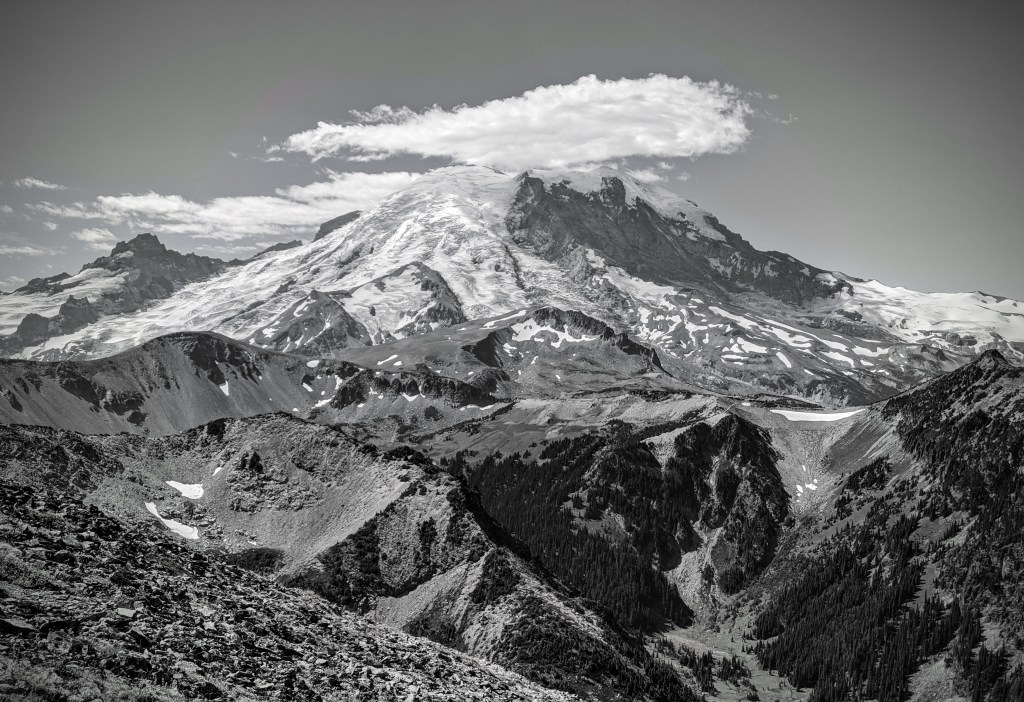
(Photo: Sif/Aaron Seaman, Mount Rainier, Washington State, 2020)
Cold. Brutally cold.
And dark. Dark as the solar system is big.
That’s what it was like as we took our first crunchy steps toward the summit of Mt. St. Helens that February morning. Ice axes stabbing, switching hands, stabbing again. Crampons piercing bulletproof ice crust, giving purchase, and piercing again. Under the milky black of the early AM, the summit seemed impossible. After a few minutes, I looked back at where we had come from and realized that everything was now just a sea of blue starglow, us climbers like two derelict ships in the infinite black ocean.
Freshly returned from four months in Antarctica, I had thought I finally understood the soul of the cold. Overconfident and mildly out of shape, I had brought the wrong sleeping bag to spend that crystal clear night exposed at 6,000 feet in the middle of winter.
Maybe my best friend had slept, maybe not. I hadn’t.
Prior to setting out on our late-morning alpine start, both of us had done the absolute minimum to get up and don our gear. Over the jet roar of our backpacking stove, we had grunted, pointed at gear or food for the climb, and spoken as little as possible, choosing instead to siphon whatever scant warmth we could from the coffee steaming in our headlamp beams.
I had never climbed before. Not climbing like crampons and ice axes, anyway.
But from my first overnight backpacking trip with my dad—a trip undertaken with almost entirely borrowed gear because we were poor—I had known that I was born for the mountains.
To be in them and around them.
To smell the richness of their firs and cut my hands scrambling up their granite, getting their dirt in my wounds, mixing with my own blood and making me part of them forever.
The mountains were my destiny and every time things went south in my adult life, I would find myself returning to them as my only safe place.
Mt. St. Helens had simply been an extension of my becoming, and that morning was my first test.
My best friend had been my climbing instructor as my dad and I had been his introduction to the mountains as kids.
Growing up, my father had been the classic Clark Griswold—short on experience yet inexplicably long on bravado. On our first trip as a trio, my dad had ended up leading us on a perilous (and failed) attempt as young teenagers to climb the remote, 10,500-foot Glacier Peak with an old sisal rope, his work boots, and a pair of cutoff jean shorts. I don’t even think he wore a shirt the entire time. This, after getting us all lost more than a few times in the infamous “Kennedy Triangle” — a complicated, poorly-marked, and apparently infamous section of remote trail. We all eventually made it back to civilization, with that trip serving as the wilderness bond that would hold our friendship together for the next few decades.
By mountaineering alpine start standards, we had slept in like lazy teenagers on a Saturday morning. Later, on bigger, more technical climbs, I would find myself setting alarms for midnight or one in the morning, always fumbling in the dark, drunk on the heady buzz of no sleep.
This morning, however, had been cut into easily digestible bites. Thanks to sleeping high above the tree line on the south flank of the mountain (which I later learned was against the rules), we only had a few thousand feet of climbing left. The morning sky was crystalline, and the wind was light and variable, a gift to our two frozen carcasses marching stepwise up the glass slope.
Being up early is nothing new for me. After years in the military and emergency services, I never—ever—sleep in anymore. Most mornings, even at home with a soft bed and a warm cat, I’m still up somewhere around 4:30 am. Past partners have complained, and I’m required to explain that if I could sleep in, I obviously would. Luckily what might be a problem for partners was never a problem for the mountains, and it wasn’t that morning on Mt. St. Helens, either. All we had to do under the wan azure glow of early morning Cascade stars was keep moving. Sleep was not required.
My best friend and climbing partner had told me on many occasions about why he had befriended me back in eighth grade. He usually recounted how I used to bully him, but that it was smarter to make friends with the bully than to be his lunch. To be fair, I didn’t bully him in the physical sense so much as mercilessly tease him for his bouffant strawberry blonde afro that earned him the coveted (and hated) nickname of a character from a popular early-90s MTV cartoon. Maybe this is just me downplaying what a gigantic asshole I’ve been in my life. I’m not sure. I’m introspectively challenged. But, from the day he decided we were going to be friends, that was it. We were friends.
The transition from enemies to eventual brothers was swift, and I quickly (and gladly) exchanged my absentee-via-work single father for his tangible, palpable, parents. I soon became a fixture at his house, coming over so much that his mother started to discipline me along with him. That was fine by me. Getting punished by his parents, like pain, was a sign of life, confirming that they were real and that I, by proxy, was also real and worthy of regard in any form. This, at an age when I spent most of my time feeling fake and alone.
We spent countless Seattle summers in his room listening to old Grand Funk Railroad, Pink Floyd, or whatever new early-90’s grunge or metal we could stuffed our fat, stoned, teenage faces with.
Most weekdays, I unskillfully inserted myself into dinnertime at his house, as mine was likely still dark and empty, the idea of the millionth microwave burrito dinner that year uninviting to say the least.
We walked to school together, marched in band together, and skied and hiked together.
Eventually, in the years after high school, I would be the first to leave, enlisting in the Navy after 9/11. He also left Seattle, eventually winding up in Alaska and learning much of the mountain-craft that he would eventually teach me. By the time we were stepping through the quiet cold on the starlit upper reaches of St. Helens, he had been back from Alaska for a few years, and I had just gotten out of the Navy.
I kicked with my boot, stumbling, catching my Gore-Tex with a spike from my 12-point crampons. My knee slapped the crust and I stabbed the pick end of my ice axe into the hill as a hasty anchor.
That’s the thing about St. Helens in the winter. It isn’t highly technical by any means. Basic self-arrest and mountain skills, some decent weather, and an alarm clock are really the only things required to summit. I, however, barely had the luxury of basic self-arrest skills, and I had most certainly never worn crampons before. Everything else had been luck.
He stopped up ahead, turning around to check on me.
I waved him off, giving the thumbs up as I righted myself, throwing my hands up in mock frustration.
We both kept moving.
Mt. St. Helens, or “Loowit” in Native American, had over one thousand feet blown off the top when it famously erupted in May of 1980. I can remember my mother telling me in my early years about “being in her belly” when it happened. And I remember seeing the huge piles of ash along Interstate 90 in Eastern Washington afterwards, themselves like small, unnamed mountains out near Moses Lake. I had been to the mountain a few times as kid, but I had never in my entire life thought that I would be climbing to the top, let alone in winter. Luckily, what I lacked in skill, I made up for in sheer ignorance.
By the time we had reached 7,000 feet, the inky black dome that had engulfed us since we set out was now deep violet in the west and teasing a seething red just above the surface of the horizon in the east. Above us, I could see the headlamps of another group of climbers on their way to the summit.
They had apparently gotten an earlier start.
The day before, we had both jumped away from the trailhead, anxious to start humping it up the winding slopes. We had taken our time, enjoying the sun and snow on our way up, and still managing to arrive at camp well before sundown. That first day, like our summit morning, had been another perfect specimen of Pacific Northwest winter mountain weather luck. At one point, it had felt so warm from the sun reflecting off the snow that I wanted to take a break and strip off my shirt. I had learned that trick—that snow reflects a lot of heat from the sun—at McMurdo Station, Antarctica, where I would bathe myself shirtless on the ice sheet while waiting for C-17s to land. Our day climbing to camp had been like that. A perfect specimen of dirtbag heaven.
After stopping for the day and picking out our camp spot, we began setting up the tent and sleeping bags, laying out our cooking area, and doing a bit of exploring. As dusk approached, we pulled our closed cell foam pads out onto the rocks, took a seat, and began to boil water. From our perch at 6,000 feet, with the beginning of a flawless stardrop background and vivid gradients of pink and deep blue, I could see the glowing summits of St. Helens’ sister volcano, the hulking 12,000-foot Mt. Adams, to the east. To the south was the pointed spire of 11,000-foot Mt. Hood and, almost another half-state away, Mt. Jefferson’s breathless, 10,000-foot symmetry.
That evening, surrounded by our glacial cathedral as the wind whispered tales of ancient cinder, we were a congregation of mountain worshipers who had finally met our true gods.
Before we lost the light, I snatched my gigantic early-model DSLR digital camera from my pack.
In my favorite photo, the camera frame is level, but we’re cocked to the side, looking off kilter due to the slope. We had set it on a rock and used the timer function, hoping we would get it right. Standing side by side, he and I are skylined, with the looming frame of Mt. Adams in the background…
The moon is up early, and we’re smiling.
The light behind us is fading as the foreground burns in pink and orange alpenglow.
The flock has come home.
By the time the sun had come up on our way to the summit, the wind had already decided to start blowing. This phenomenon happens anytime weather systems are in flux. Rain replaces sun, replaces rain, each time the systems bring in some wind while they fluctuate. In the Pacific Northwest, all that glitters is not clear and sunny, and it was obvious that another system was moving in to take the place of our exiting high-pressure ridge. We weren’t in any type of danger, but the more the wind blew, and the clouds stalked, the more we forced our way up the slope.
Soon enough, we could see the crater rim in sight a few hundred feet above.
A few minutes after that, we couldn’t go any higher.
We were officially on top.
Mt. St. Helens had not only the top one thousand feet blown off in the 1980 eruption, but also the entire north side of the mountain. That entire flank is simply…gone. What remains, instead of the “Mt. Fuji of the West” as it used to be called, is less a stunningly symmetrical stratovolcano and more an odd-shaped horseshoe with a thousand-foot lava dome in the center. This horseshoe, however, is of epic proportions. At over a mile and half long, the crater rim circles high above the surrounding peaks at over 8,000 feet until it simply disappears into the ether. Then it’s just nothing until it reappears magically another half-mile later.
Mt. St. Helens is a broken, shattered mountain still trying to reconstruct itself after a life of traumatic experiences—feelings I’m intimately acquainted with. We’re kindred spirits, ever searching for safety, or maybe even some sort of redemption. But that second on the summit as I finally set my pack down, stabbed my ice axe into the snow, and dug for my tiny string of Buddhist prayer flags for my summit photo, I felt anything but broken. I felt loved—by the mountain and by my best friend who had shared that journey with me.
Most importantly, for the first time I finally felt real.
After sharing our few minutes at what felt like the top of the world, we packed up, strapped up, and plunge-stepped our way back down to camp to grab our stashed gear. The weather system we saw coming from the summit never did materialize, instead simply washing us in a blanket of high gray clouds, eventually even giving way to partial sun. I took my time, savoring the last bit of my first climb, while my best friend strapped on his skis and got some turns in before waiting for me to catch up. After returning to the trailhead, we packed up my black Subaru and sped back to Seattle, never shutting up about our next mountain.
In the coming years, my best friend would teach me how to rock climb, backcountry ski, and how to use both in mixed alpine routes—all things that had been passed on to him by his own cadre of dirtbag gurus. Both of us also got married (or remarried in my case), grew up, and moved away. First, me to the east side of the state for a job with the Forest Service. Next, him and his new wife for her job as a doctor.
For a few years, we’d try to coordinate but life would usually get in the way. One day, five years after that life-changing summit, he sat me down at a small mountain town coffee shop. Over breakfast he told me exactly why our friendship had declined for the last few years—a situation I hadn’t been aware was happening. To my surprise, not all of “life getting in the way” had been simple scheduling conflicts or our physical distance. My heart was broken.
He and I both made promises after breakfast, hugging in the parking lot and promising to get back on track, but neither of us ever did. We just let the years slide by in silence until we had both moved on geographically and emotionally.
Had I known that breakfast would be the last time we spoke as adults, I may have said or done something different, but I didn’t. I just waved as he drove off, watching our friendship disappear into the ether like the north side of Mt. St. Helens.

 thedecline.net
Leave a comment